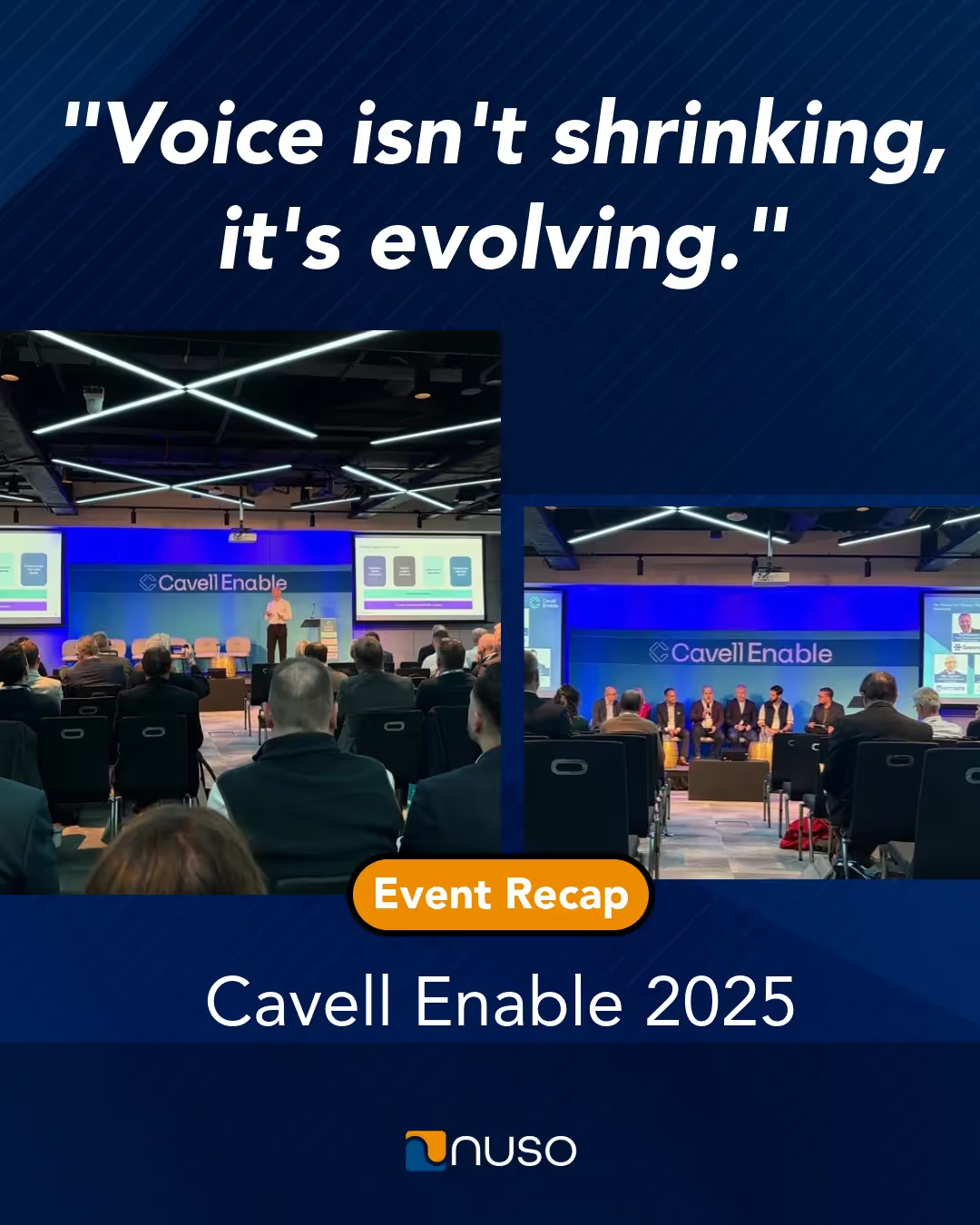



If Cavell Enable 2024 was about cloud maturity, then Enable 2025 was about momentum. Momentum in AI adoption. Momentum in the shift from on-prem to cloud. Momentum in the evolution of service provider business models. And perhaps most strikingly, momentum in the one area everyone assumed was fading: telephony.
Across the day, one theme kept resurfacing from keynotes to panels to data deep-dives:
Voice is not dying; it’s transforming. And it is becoming the anchor for AI-powered productivity, customer experience, and collaboration.
There were a few sessions that stood out and really hit these messages home.
Status Quo vs. Evolution
Zoom’s Jamie Hill on the Real Transition Facing Providers
Jamie Hill, Head of Global Phone Channel at Zoom, framed the industry’s defining challenge succinctly:
"Service providers must balance highly profitable, fully depreciated on-prem assets with the undeniable shift toward higher-growth cloud platforms."
The Market Signals are Unmistakable
- Legacy TDM and IP-PBX deployments are in double-digit decline.
- UCaaS and CCaaS are growing at nearly the same pace.
- Customers are driving and expecting cloud-first strategies, heavily influenced by AI innovation.
Zoom’s answer is its Service Provider Program, built so partners can:
- Package and bundle Zoom Phone, Meetings, and Contact Center within their own offers.
- Inject their own PSTN, SIP, DIDs, SMS, and compliance layers.
- Deliver Tier 1 support while escalating directly to Zoom for Tier 2.
- Maintain margin control while using Zoom’s scale.
Making What Is Old, New Again
Jamie’s most resonant message was simple: Telecom is more than 100 years old. AI is making it new again.
Zoom Phone’s rapid expansion to over 10M seats is being accelerated by:
- AI-generated summaries of calls, meetings, and even entire days.
- Live “catch me up” capabilities mid-call.
- Voicemail transformed into usable, actionable insight.
- Predictive, intelligent routing replacing traditional IVR.
- A future of voice-based agents performing tasks autonomously.
Jamie’s examples, especially automated voicemail scheduling and agentic workflows, made it clear that voice is shifting from a static utility to a dynamic, AI-rich data source.
The Future Is Calling
Microsoft’s Taimoor Husain on Voice as the Natural Interface for AI
Taimoor Husain, Global Business Manager at Microsoft, connected AI transformation directly to telephony:
“Voice is the most natural way to interact with technology.”
His message was unequivocal: the real AI opportunity for service providers lies in voice-driven workflows, real-time translation, and agentic systems that act, not just assist.
Why Telephony Placement Matters More Than Ever
Microsoft showed how the industry moved from analog to IP, then to cloud, and is now entering the AI reasoning era.
AI requires access to:
- Emails
- Meetings
- Documents
- Chats
- Calls
If providers place telephony outside of Microsoft Teams or the enterprise collaboration estate: AI can’t reason holistically over user activity, which means customers won’t realize the full value of Copilot. Enterprises are waking up to this new reality.
Real-Time Translation: The Breakout Opportunity
Of the new capabilities Microsoft is prioritizing, Taimoor highlighted one as truly transformational: Real-time, live translation during phone calls.
Dozens of languages, instantly translated, in-call. This has massive implications for global enterprises, customer service, and accessibility and creates a new category of demand for service providers.
The Rise of First-Party And Partner-Built AI Agents
Microsoft is pushing hard into:
- AI facilitator agents
- Interpreter agents
- Task-based voice agents
- Low-code/no-code agent creation through Copilot Studio
This aligns perfectly with the message from Zoom: AI agents will reshape how users interact with communications platforms and voice is the primary input.
Cavell Enterprise Research
The Only Growth in Telephony Is Inside Collaboration Platforms
Cavell’s Patrick Wilson and Finbarr Begley presented fresh data from 602 IT decision-makers across the US, UK, and Ireland.
One figure stopped the room:
"Only 6% of Microsoft Teams users today have PSTN telephony enabled."
But what matters is not the current number it’s the direction.
The Contradiction at the Heart of Telephony
- Overall business telephony usage is declining.
- Developed markets (US, UK, Western Europe) show fewer business lines every year.
- When moving from PBX to cloud, enterprises do not migrate 1:1.
- BUT collaboration telephony is growing.
- Teams Phone, Webex Calling, and Zoom Phone deployments all rise year over year.
- Over 60% of organizations plan to expand PSTN to more collaboration users.
Why This Shift from Business Telephony to Collaboration Telephony?
- Richer AI value from voice data.
- Demand for tighter integration with contact center and workflows.
- Familiarity and ease of use within collaboration suites.
- Reduced operational complexity when voice lives where people already work.
What Stops Enterprises from Enabling PSTN For Everyone?
Cavell asked those who haven’t rolled out telephony to all users:
- Limited need for external calling
- Preference for mobile devices
- Cost and implementation complexity
- Integration challenges
In Patrick’s words:
"Telephony value has been assumed for decades, but in 2025, we may need to start explaining it again."
A provocative point: Younger companies have grown up without the legacy telephony mindset. Providers must rethink how they articulate the value of voice in an AI-driven enterprise.
One Platform Isn’t Enough
Providers Are Going Multi-Marketplace
This panel with Bandwidth, CallTower, Deutsche Telekom, Gamma, NUSO, and NTT Data made one thing unmistakably clear:
Customers run multiple collaboration platforms. Providers must meet them there.
Why Multi-Marketplace Has Become Mandatory
The panelists cited several reasons:
- Customers mix Teams, Zoom, Webex, Genesys, NICE, and vertical-specific tools.
- Providers must support customers wherever they are, and wherever they are going.
- Channel partners need freedom to sell what they know and trust.
- Regulatory requirements, quality expectations, and sovereignty concerns vary by region.
- Telephony, as a mission-critical utility, requires the highest reliability across all platforms.
Bandwidth put it well: Marketplace adoption is often about making sure numbers, routing, failover, and compliance remain stable even as customers swap platforms.
The quote that captured audience attention was from NUSO’s own Matt Siemens:
“If you’re going to limp into a marketplace, there’s a good chance you’ll fail. Take a stance, have an opinion. You might beat your head against the wall for a while but at least there’ll be a dent in the wall.”
This was the rallying cry for providers who are hesitant about entering Operator Connect, Zoom’s Provider Exchange, Webex CCP, or CCaaS marketplaces.
What Providers Need from Microsoft, Zoom, Cisco, And Others
The panel was candid:
- Better margins
- Easier partner programs
- More open ecosystems (less “walled garden”)
- Stable APIs and change management
- Easier automation
- Strategically consistent partner models
And critically: Marketplaces must make it easier for enterprises to run multiple platforms side-by-side without operational pain.
6 Keys For Providers Entering Their First Marketplace
Know exactly why you’re doing it.
Be selective, complexity kills execution.
Bring differentiated value, not just dial tone.
Understand your ideal customer profile and vertical strengths.
Look beyond the Big Three, niche platforms and AI integrations matter.
As Matt Siemens put it:
“Be bold, not tentative.”
The Big Picture: Why Cavell Enable 2025 Mattered
Taken together, the sessions delivered a coherent and powerful set of messages:
- Voice is becoming the key input signal for enterprise AI.
- Telephony embedded in collaboration platforms is the part of the telephony market that is growing.
- AI agents, live translation, and voice-rich intelligence are redefining user expectations.
- Marketplaces are the new route-to-market battleground and providers must master several, not one.
- Service providers that combine telephony, AI, compliance, and multi-platform enablement will lead the next phase of the industry.
The shift is no longer about cloud migration. It’s about AI-powered voice transformation and platform-agnostic enablement.
Cavell Enable 2025 didn’t just preview the future, it made it clear that the future is already here.