

The modern workplace has irrevocably changed. Workforces are distributed across offices, homes, and mobile environments; teams collaborate through voice calls, video meetings, chat, and shared screen workflows; and communication tools like Microsoft Teams and Zoom are now central to how business gets done.
This shift presents a new set of opportunities but also new risks. For organizations in regulated industries such as financial services or healthcare, the biggest risk isn’t losing productivity; it’s not capturing, securing, and governing information in a way that stands up to regulatory, legal, and operational scrutiny.
In this era of hybrid and multi-platform communication, compliant recording is no longer a “nice-to-have.” It’s a business imperative.
Hybrid Work = More Collaboration Channels, More Compliance Exposure
Hybrid work has created a complex ecosystem of digital communication channels far beyond traditional desk phones or localized systems. Teams now span multiple platforms, devices, and modalities, increasing the likelihood that business-critical interactions occur outside of governed systems.
According to industry analysis, enterprises are no longer relying on a single communications platform. In a recent UC Today piece, survey data showed that around 50% of enterprises use four to six different communication tools, and nearly a third use seven to nine platforms simultaneously. This multi-platform reality is here to stay, and traditional governance tools weren’t built to handle it.
As communications proliferate across tools designed for flexibility and collaboration, gaps in recording become compliance blind spots.
What Compliance Recording Really Means in a Hybrid World
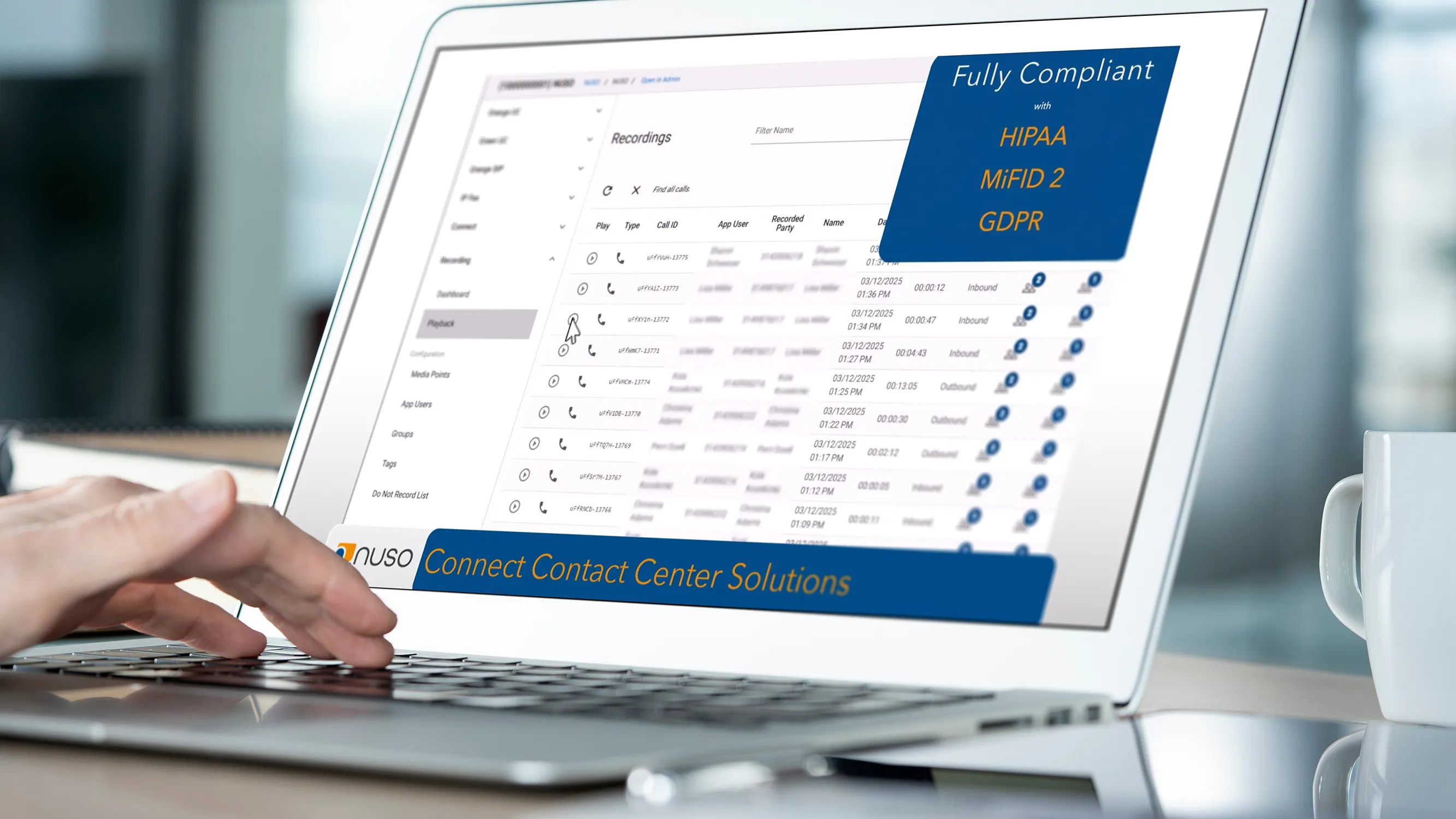
At its core, compliance recording is more than pressing “record.” Microsoft’s documentation on compliance recording for Teams highlights the difference: compliance recording is designed to capture and store communications automatically and securely, along with sufficient metadata to meet global regulatory requirements such as HIPAA, MiFID II, and GDPR. Native convenience recording where a user chooses to record a session is not enough in regulated environments.
True compliance recording systems are capable of:
- Recording voice, video, screen sharing, and persistent communications
- Capturing and storing communications based on policy, without user intervention
- Retaining records securely for audit, legal discovery, and regulatory review
- Applying configurable retention schedules and access controls
Without these capabilities, organizations risk failing audits, legal exposures, and operational disruptions.
Hybrid Work, Compliance Risks, and Operational Blind Spots
Hybrid work requires communication flexibility and so it creates compliance complexity. Some hybrid compliance challenges now extend beyond traditional email or phone systems into areas like video meetings and AI-augmented interactions.
Regulators increasingly don’t differentiate between communication modalities. An internal Teams chat, a customer video call, a screen-share during a client meeting: all can be subject to the same regulatory requirements if they contain business-critical or protected information.
Compliance and AI
As with all technologies, the communications compliance landscape is changing rapidly. As one compliance expert noted, if AI-generated meeting summaries and chat transcripts aren’t captured and governed, organizations may face regulatory scrutiny just as they would for human-generated content.
“You are just as responsible for AI-generated content as you are for human-generated content,” warns Garth Landers, Director of Global Product Marketing at Theta Lake.
Furthermore, watchdogs such as the U.S. Securities and Exchange Commission have warned that companies must address compliance issues raised by increased use of personal devices and new communication channels in hybrid working models, or risk falling short of oversight expectations.
Industry Use Cases: Why Compliance Recording Matters
Financial Services
Financial firms operate under stringent regulatory regimes that require retention of trading communications, advice, and approvals often for years. In hybrid environments where advisors engage with clients via voice calls, Teams meetings, and digital chat, compliant recording becomes a critical component of supporting regulatory obligations. Missing or incompletely archived interactions could lead to enforcement actions or financial penalties.
Healthcare
Healthcare organizations must protect patient data and ensure communication documentation is both secure and auditable under HIPAA and similar privacy regulations. Compliant recording systems help healthcare organisations capture clinical discussions with the appropriate privacy and security controls.
From Governance to Insight: The Broader Value of Compliant Recording
While the primary driver for compliance recording is risk mitigation, organisations are increasingly recognizing the business intelligence value that governed recordings can deliver.
Recorded interactions, when transcribed and indexed, provide searchable evidence that information was exchanged and how decisions were made. They enable quality assurance teams to identify training opportunities, help managers discover patterns of client sentiment, and support data-driven decisions with context-rich dialogues.
This transforms compliance recording from a regulatory checkbox into a strategic operational asset.
Building a Compliant Recording Strategy That Supports Hybrid Work
Implementing an effective compliant recording strategy requires more than adopting a tool; it requires alignment between technology, policy, and organizational workflow.
Best practices include:
- Establishing clear policies for what must be captured based on role and regulation
- Choosing recording systems that integrate with every communication platform in use
- Automating capture and retention wherever possible to reduce manual risk
- Ensuring secure storage and access controls aligned to data governance standards
Compliance recording isn’t just about capturing data, it’s about ensuring that data is usable, trustworthy, and defensible.
The Bottom Line for Compliance in Hybrid Business Environments
In a hybrid workplace, where communications happen across platforms, devices, and modalities, the risks of ungoverned communications are too great to ignore. Compliant recording is a core part of modern governance and risk management strategies and it’s increasingly a prerequisite for operating with confidence in regulated industries.
As the workplace continues to evolve, organizations that proactively address communication compliance will not only reduce risk but also gain visibility into the conversations that shape their business outcomes.
ITExpo 2026
Heading to ITExpo ‘26 in Fort Lauderdale, Florida?
Stop by our booth! We’ll be discussing the future of compliant communications. Schedule a meeting ahead of time and reserve your spot to explore how compliance‑grade recording can transform your operations: https://lp.nuso.cloud/meet-nuso-at-itexpo-2026.