
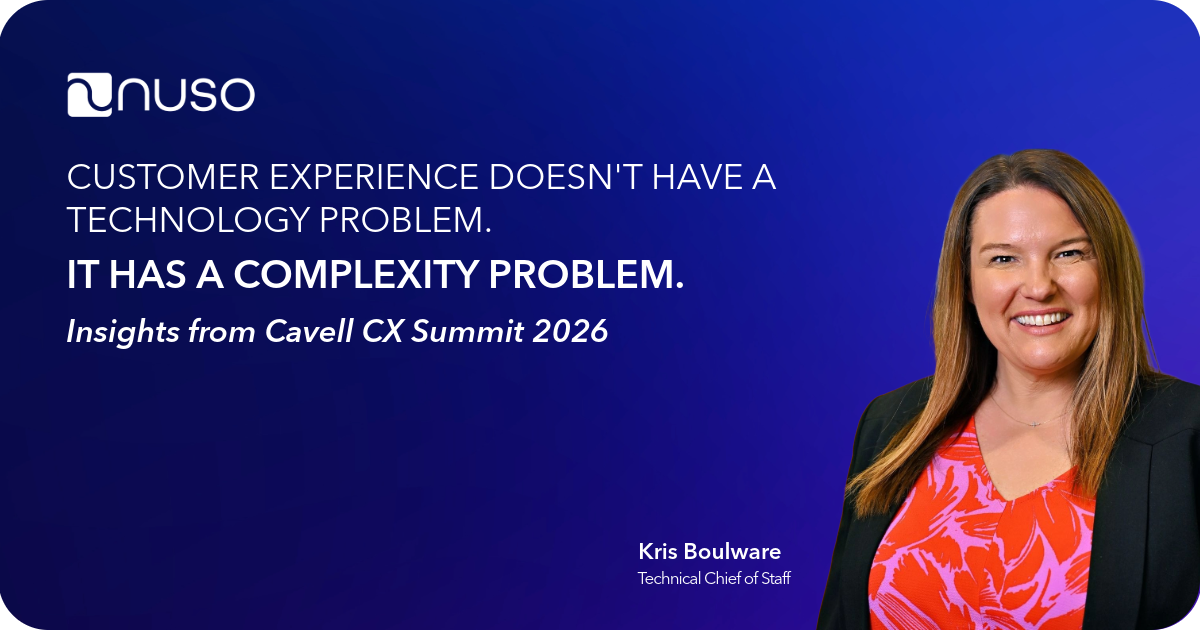



Kris Boulware, NUSO Technical Chief of Staff
Last week, I attended Cavell's inaugural CX Summit in London.
As expected, AI dominated the conversation. Every vendor had an AI story. Every analyst had an AI prediction. Every roadmap seemed to include more automation, more intelligence, and more data.
But after a week of conversations with customers, partners, vendors, and industry leaders, I came away with a different takeaway.
The biggest challenge facing customer experience today isn't AI. It's complexity.
Customers Care About Outcomes, Not Features
For years, CX technology has been sold through feature comparisons.
More channels. More integrations. More dashboards. More capabilities.
That conversation is changing. Customers aren't asking what a platform can do. They're asking what it can deliver.
Can it improve customer satisfaction? Can it make employees more productive? Can it reduce costs? Can it create measurable business value?
The vendors gaining attention aren't leading with feature lists. They're leading with outcomes.
That's a healthy shift for the industry.
We've Added Technology Faster Than We've Removed Complexity
One theme surfaced repeatedly throughout the event. Most organizations already have plenty of technology.
What they don't have is simplicity.
Customer journeys span multiple systems. Agents work across multiple applications. Data lives in multiple places. Every new challenge seems to result in another tool, another integration, or another dashboard.
The result is a customer experience stack that continues to grow more complicated. Ironically, many organizations aren't looking for more innovation. They're looking for less friction.
AI Has a Context Problem
The conversation around AI has also matured. A year ago, organizations were asking whether they should adopt AI. Today, most have already started.
Now they're facing a different challenge. Too much information.
AI is generating summaries, recommendations, sentiment scores, insights, alerts, and analytics at a scale that many organizations struggle to operationalize.
The issue isn't access to data. It's turning data into action.
The companies seeing the most value from AI aren't necessarily using the most AI. They're the ones connecting AI to customer context, business processes, and operational decisions.
Without context, AI creates noise.
With context, AI creates outcomes.
The Next Opportunity Is Simplification
My biggest takeaway from Cavell was simple:
Customer experience doesn't have a technology shortage. It has a coordination problem.
The next generation of CX won't be defined by who adds the most features.
It will be defined by who can bring communications, customer data, workflows, automation, and intelligence together in a way that's easier to operate.
Customers want fewer silos. Fewer disconnected systems. Fewer handoffs. Less complexity.
The organizations that can deliver that simplification will create the most value over the next several years.
And after spending a week at Cavell CX Summit, that's the trend I'm watching most closely. Many organizations are rethinking how communications, customer experience, and AI fit together in a world where complexity continues to grow.
If your team is evaluating ways to simplify operations, improve customer outcomes, or better operationalize AI, I'd welcome the opportunity to compare notes and share what we're seeing across the market.